

Some destinations earn their place on a travel itinerary purely because of what’s on the plate. Food markets around the world offer an unscripted, sensory experience that no restaurant reservation can replicate and a few of them are so extraordinary they justify booking the flight.
When a Market Becomes the Destination
Most travelers treat food markets as a pleasant detour — a quick stop between museums or a shortcut to a cheap lunch. But certain markets carry enough cultural weight, culinary depth, and sheer variety that they transform into the main event. These are the places where a city’s identity is most honestly on display, not polished for tourism but lived in daily by the people who call it home. Planning a trip around one of these markets isn’t eccentric — it’s one of the most rewarding ways to understand a place.
The best food markets share a few traits: they’re rooted in local history, they serve food that can’t easily be replicated elsewhere, and they attract a mix of regulars and visitors who come specifically for the experience. Whether sprawling across a historic district or popping up seasonally in a public park, these destinations earn their reputations one bite at a time.
North American Markets That Demand Attention
Seattle’s Pike Place Market has operated continuously since 1907, covering nine acres in the city’s historic downtown and hosting more than 500 independent businesses (source). It ranks among the most-visited tourist attractions on the planet, yet it retains an authenticity that keeps locals returning week after week. Fresh Pacific seafood, artisan cheeses, handmade crafts, and flower stalls pack the walkways, and the market’s position overlooking Elliott Bay gives the entire experience a dramatic backdrop.
Philadelphia’s Reading Terminal Market opened in 1893 and remains one of the country’s premier public markets, where shoppers can browse more than 80 vendors selling everything from farm-fresh produce to Amish baked goods and a scoop from Bassetts, the oldest ice cream company in the United States (source). The market’s age is part of its appeal — it feels like stepping into a living archive of American food culture.
In Los Angeles, Grand Central Market has anchored the corner of Broadway and Hill since 1917, occupying a landmark Beaux-Arts building and featuring around 40 stalls that celebrate the immigrant communities who built the city (source). The lineup spans ceviche tostadas, Korean home-style cooking, fresh-pressed juices, and much more — a single afternoon there reads like a food tour of the entire city.
New Orleans brings its own irreplaceable character to the French Market, a cultural institution with two centuries of history behind it. Jambalaya, étouffée, and the legendary Muffuletta sandwich anchor the savory offerings, while Café Du Monde — operating since 1862 — keeps café au lait and beignets flowing around the clock (source). Few markets in the country feel as inseparable from their city’s mythology as this one.
New York adds two entirely different market experiences worth building a trip around. Brooklyn’s Smorgasburg launched in 2011 and grew into the largest weekly open-air food market in the country, earning the nickname “the Woodstock of Eating” from The New York Times, with locations now operating in Los Angeles, Miami, and Atlanta as well (source). Meanwhile, Queens Night Market surrounds Flushing Meadows-Corona Park each season with stalls representing cuisines from more than 95 countries, nearly all priced accessibly to keep the crowd as diverse as the menu (source).
Global Markets With Legendary Reputations
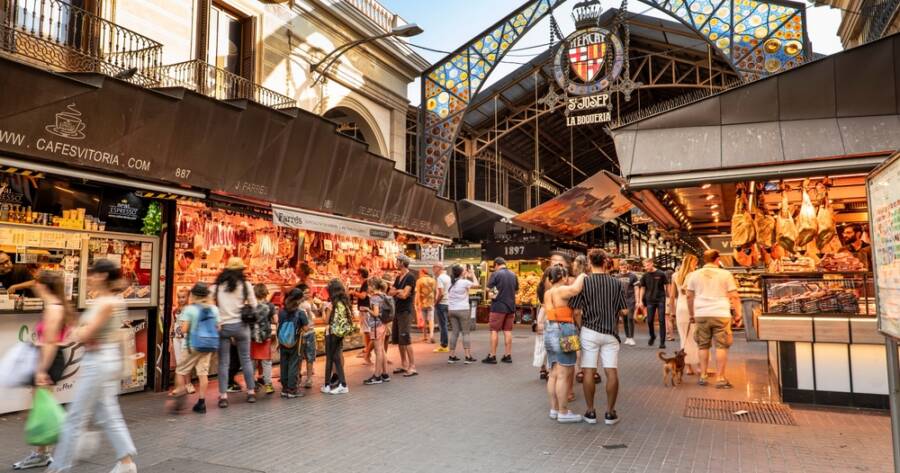
Barcelona’s La Boqueria is one of Europe’s most storied food destinations, tracing its origins back to a traveling market that first appeared in 1217 (source). Today, more than 200 vendors fill its iron-and-glass hall with jamón ibérico, fresh-caught seafood, tropical fruits flown in from around the world, fragrant spice counters, and vendors pressing juice to order. It sits just off La Rambla, making it easy to reach but endlessly difficult to leave.
Old Delhi’s Chandni Chowk carries history in every alleyway, dating back to the 17th century when the Mughal emperor Shahjahanabad designed the city around it (source). The market remains one of India’s most vibrant and chaotic food destinations, where daulat ki chaat, chole kulche, deep-fried parathas, slow-cooked kebabs, and sugar-drenched jalebis compete for attention at every turn. For food travelers willing to embrace the sensory overload, it delivers an experience that is genuinely unrepeatable.
These international markets share something important with their American counterparts: they aren’t theme parks built around food — they’re living institutions where generations of vendors, recipes, and regulars have created something far more meaningful than a meal. Visiting them with intention, not just as a side trip, changes the way a traveler engages with an entire city.
Why You Should Learn More About Food Markets Worth Traveling For
Food markets represent some of the most authentic cultural experiences available to any traveler. From a 13th-century Catalan trading post turned gourmet hall to a seasonal Queens park transformed into a globe-spanning food festival, these destinations connect visitors to the people, history, and flavors that define a place. Planning travel around a great market means prioritizing genuine discovery over standard sightseeing — and it tends to produce the most vivid, lasting memories a trip can offer. Whether the destination is a century-old American institution or a medieval European bazaar, building an itinerary around extraordinary food markets is a deeply satisfying way to see the world.