

Spending hours at a desk, driving, or relaxing on the couch can leave your muscles feeling tight and uncomfortable. The neck, shoulders, back, and hips are especially prone to stiffness when you remain in one position for too long. Fortunately, a few simple stretches can help restore comfortable movement and ease muscle tension. Better yet, several exercises require little equipment, making them practical additions to your workday or daily routine.
1. Seated Neck Stretch for Upper-Body Tension
Looking at a computer monitor or smartphone for extended periods can contribute to neck discomfort, particularly when your head remains tilted forward. A gentle neck stretch can help loosen muscles around the cervical spine and make turning your head more comfortable.
Sit upright in a sturdy chair with your feet flat on the floor. Relax your shoulders and slowly lower your chin toward your chest. Hold for 15 to 30 seconds before returning to the starting position. Next, gently turn your head left, then right, holding each position for 15 to 30 seconds. Finish by tilting your ear toward each shoulder without raising your shoulders (source).
2. Cross-Body Shoulder Stretch for Desk-Related Tightness
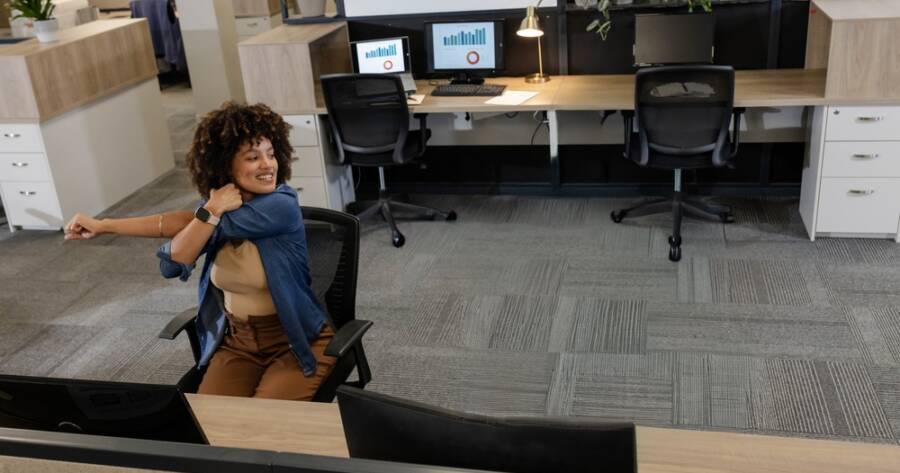
Extended periods of typing or working with your arms positioned in front of your body can leave your shoulders feeling uncomfortable. The cross-body shoulder stretch targets muscles at the back of the shoulder and helps maintain flexibility for everyday reaching movements.
Begin sitting or standing upright. Bring your right arm across your chest, keeping it approximately at shoulder height. Use your left hand to support the right arm just above or below the elbow, gently drawing it closer to your body until you notice mild tension behind the shoulder. Hold for approximately 30 seconds, then switch arms (source). Avoid pulling forcefully or twisting your torso.
3. Seated Spinal Rotation to Improve Back Mobility
Remaining seated in a fixed position can make your middle back feel rigid, especially when you rarely turn your torso throughout the day. Seated spinal rotation introduces gentle twisting movements that encourage mobility through the back without requiring you to get onto the floor.
Move toward the front of a stable chair and sit tall with both feet planted. Slowly turn your head to look over your left shoulder, then continue rotating your shoulders and upper body in the same direction. Move only as far as feels comfortable, maintaining an upright position rather than forcing the twist. Hold for 10 seconds, return to the center, and repeat on the opposite side. Perform two or three rotations per side, following the seated trunk rotation instructions (source).
4. Seated Figure-Four Stretch for Tight Hips
Sitting for long periods keeps your hips in a bent position, which can contribute to a sensation of tightness around the hips and buttocks. The seated figure-four stretch targets these areas while allowing you to remain comfortably supported by a chair.
Sit firmly with both feet on the floor. Lift your right foot and rest your ankle across your left thigh, just above the knee, creating a figure-four shape. Keeping your spine straight, slowly lean forward from your hips until you feel a comfortable stretch through your right hip and buttock. Hold for 20 to 30 seconds, breathing normally, before switching legs (source). Repeat twice on each side. Avoid pressing aggressively on the raised knee.
5. Seated Hamstring Stretch for the Back of Your Legs
The hamstrings run along the backs of your thighs and help control movements involving your hips and knees. When these muscles feel tight, bending forward or straightening your legs may become uncomfortable. A seated hamstring stretch offers a convenient way to work on flexibility during breaks.
Sit near the front edge of a sturdy chair and straighten your right leg in front of you, keeping your heel on the floor. Maintain an upright back as you slowly hinge forward from your hips until you feel a gentle stretch behind the thigh. Hold comfortably for about 30 seconds, return upright, and switch legs (source). Avoid rounding your back or bouncing toward your foot. This movement follows a seated hamstring stretching technique.
Making Stretching Part of Your Daily Routine
Stretching works best when paired with regular movement rather than used as a replacement for physical activity. Consider standing up or walking briefly every 30 minutes to interrupt prolonged sitting. Before deeper stretches, warm up with gentle movement, breathe normally, and never push through pain.
Start with whichever exercises address your most noticeable stiffness and gradually develop a consistent routine. If you have an injury, persistent pain, or a medical condition affecting movement, consult a healthcare professional before beginning. Small, regular movement breaks can make long periods of sitting more manageable.